
The End of Reason?
The Rational Tradition's Final Proponents Duel to the Death.

The intellectual transition towards modern world—and consequently man’s place in it—began substantially with the revolutionary thinkers of the seventeenth and eighteenth centuries. After Descartes separated the observer from the reality around him through the cogito, Kant began the more careful project of further defining the inner categories of intelligence which sever consciousness from things in themselves—the phenomena and their noumenal reality. The path towards knowledge, somewhat clearer in the Aristotelean empiricism of the previous age, was now significantly muddied—while simultaneously gaining “surer footing” on the rational plane. However, if the intellect was no longer dealing with objects as they are, what other paths remained for the seeker of truth?
Further thinkers provided further answers. Hegel provided a valiant attempt to salvage and reconstruct the old world’s metaphysics through his phenomenological lens, positing that the rational was synonymous with the real—yet this still left the observer in a state more or less mired in conceptual subjectivity (his senses do not infer the identity of things). Schopenhauer (evading the intellect) instead sought a path through the primacy of the will, only to find that it also was in bondage and must be rejected. Nietzsche followed his teacher Schopenhauer where he would not go: following the will and its expression to its final end, he concluded that, in the absence of objective morality (a spook, if anything), the personal will must blossom as widely and strenuously as possible in its domain. Building upon this concept, Freud maintained that mass discontent stemmed from a suppression of the true will in the id by societal norms which prohibited its expression (following the pleasure principle).
Lastly, and on somewhat different grounds, Heidegger would attempt to look past the Hegelian emphasis on the intellect and the Schopenhauerian emphasis on the will. Turning to being instead, Heidegger introduced man as a self-reflective being who, through the primacy of freedom, discovers his essence through what he does. The brute fact of existence—separated from abstract concepts and societal norms—is revealed by the innate nothingness at the core of reflective beings, encouraging them to live authentically as they are. Weber might phrase this as the kind of masculine courage needed to face the facts; Nietzsche might have called it good digestion. Against Descartes, Heidegger places man back in the real world—but a kind of subjectivity remains in the search for meaning.
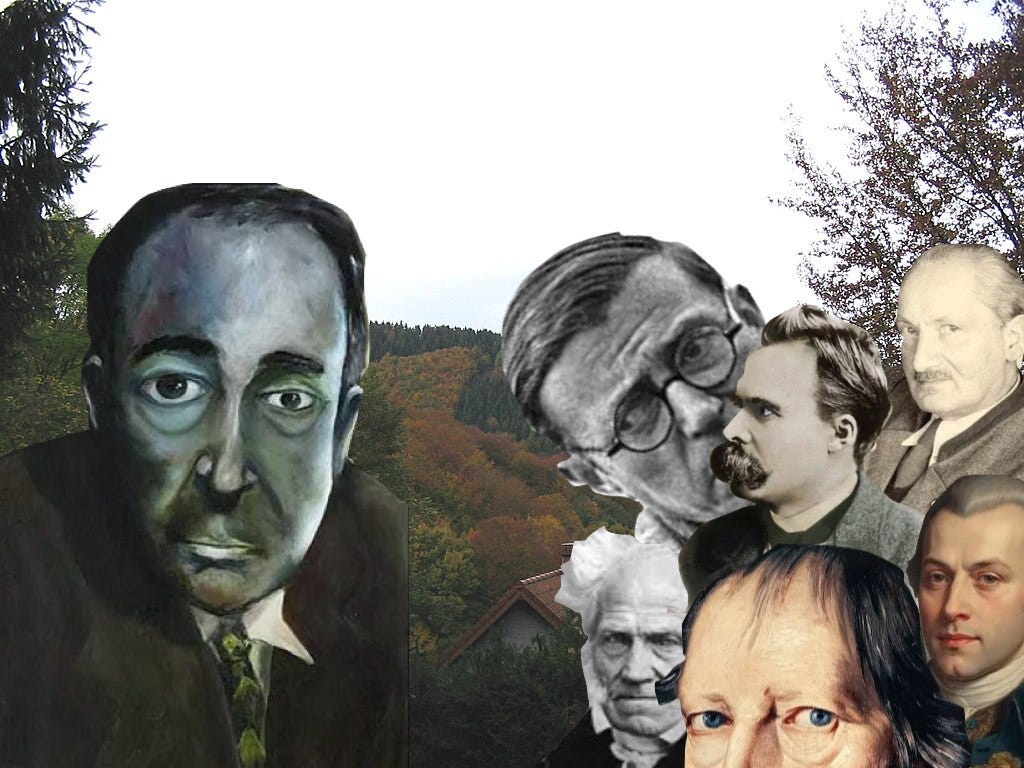
Following the preceding philosophical developments, one sees a gradual unfolding in modern man’s search for truth: what he justifiably knows is himself (Descartes); his ability to deduce concepts from sense perception is abolished (Kant); his unbound will is fundamental in his activities in the world (Schopenhauer through Nietzsche and Freud); and he may disclose who he is through the expression of his personal existence (Heidegger).
This last development is essential in understanding the existential philosophy of Jean-Paul Sartre: that man, whose existence (or fact of being) precedes his essence (or definition), must mete out his own meaning. This would seem to be the natural conclusion of Heidegger’s thought. If at the heart of man is a nothingness, and if he discovers his essence (definition) through the act of being, would not the likely conclusion be that man creates his own essence? After all, if man is a free and self-reflective being, it is he alone who exists according to himself—he makes the choices which disclose his identity. This would seem to suggest that, rather than essence preceding existence (as the traditional philosophies would propose), existence (the fact of being and its activities) would precede (and decide!) essence. To be is to do, posited Kant. Did he fully understand the consequences of the converse—to do is to be?
Sartre proposes that man is to make an art or project of his life. How could it be otherwise, considering the preceding givens? Man is entirely free and responsible to himself alone—which is to say dually that he answers to no-one and, unfortunately, there is no one to answer for him. There is no higher court of appeal in Sartre’s conception—be it God, the church, the state, or your neighbor—resulting in the anguishing position of having the weight of the world’s meaning upon your shoulders. With no God or metaphysical source to impute meaning into his life, man is met with the cost of his absolute freedom—to create his own meaning. This project (spanning one’s whole life) concerns the creation or selection of objects and causes in which to believe or commit oneself to.
There is more. Sartre argues that his existentialism is a kind of humanism. After all, whatever man chooses for himself must be (subjectively) viewed as good or desirable. From this principle, it follows that whatever good man chooses for himself is identical with the example he sets forth for all men, universally. For example, if a man commits himself to the forceful ascension of the proletariat, this act is not isolated to the individual alone—it is projected in all directions in proportion to the activity of the man, by the very fact that he has given it the value of good. The existentialist politician, although he understands his personal meaning to be grounded in no universal meaning, will follow through with his cause zealously and charismatically; he will undoubtedly attempt to move all humanity towards the ends which he has selected. That is to say, his ends—is there not a corollary to be found in Max Weber’s value-clinging politician and his cause?
But here we come to an obstacle that cannot be surmounted. The absolute freedom that Sartre proposes seems to eat its tail—but how? If the freedom provided by existential philosophy is adopted, and men begin to follow their chosen “good” with determination, it is inescapable that the project of their lives will inevitably become the project of all future lives. In other words, if the existentialist proposes that his life is an art, it follows (by the humanistic extension) that he is the painter of nearly all other lives in his reach. Absolute freedom has ended in absolute slavery; the snake has bitten its tail.
C.S. Lewis, in his Abolition of Man, has premeditated this development. In earlier chapters, he had divided and categorized what he views as the two antagonists to mankind: the innovators and the conditioners. The former (by far the less dangerous) have proposed to lay down new and certain values to inform the activity of mankind—oftentimes reducing all human action down to pre-existing principles. Nietzsche, for example, reduces human activity to the value of will to power, which he finds evident in historical acts of heroism. He goes so far as to reduce nobility and virtue down to this principle. Similarly, Freud introduces the pleasure principle as the fundamental motive behind all human behavior. He reduces humanity’s aspirations to this new value. These men are innovators: they attempt to abolish the old system’s values, but generally find themselves salvaging one traditional value, into which they subsume all others.
Sartre and the existentialist are interested in a different project. Falling under Lewis’ second category of conditioner, these thinkers are under no illusions: they understand that—at the heart of reality—there is nothingness. They have no Quixotic allegiance to any value they understand to be real—empirical or not. As stated, they impose their cause of choice onto themselves, and consequently upon the entire human race. Lewis understands this as not merely the domination of a certain generation at a certain time, but as an attempt to conform future generations and peoples to the personal values assumed by the existentialist. Whether it be by education or eugenics, future generations (as of yet unable to defend themselves or speak on behalf of their freedom) are at risk of being indelibly changed by the “master generation.” The tools of this change range from scientific developments to technological advances—the paradoxically valueless and value-full man will begin his conquest of nature by any means necessary. The men of the future will be molded in their image, while the men of the past will be debunked into the realm of myth. The only survivors will be a minority of men in the present—these are the conditioners.
By means of contrast, other modern philosophers (still innovators) were more careful. Kant (by way of his categorical imperative) assured that no man could legislate something which could not simultaneously be legislated by all men at all times—past, present, and future. Nietzsche saves himself by never claiming that all men are to experience free-reign of their wills—in fact, only the very few dominant hero-types will. Locke posited that some of the freedoms inherent in man must be restricted if he is to enter into civil society, while some would still be retained. Even Hobbes understood that civil coexistence cannot come to be if every member of the Leviathan retains his absolute freedom (no matter how unsavory his proposed remedy is).
But there is—in Lewis’ view—another way out. Taking a few steps back (even before Descartes’ cogito), perhaps there has been a misstep. Perhaps the attempt at reconstructing human values is, in the last analysis, an impossibility. Perhaps it is impossible to rationally justify reason, or to discover a new value by which all values are derived. Is it not impossible to discover a new morality without some preexisting, a priori reality? Is it not an impossible task to justify justification?
Put in other terms, the difficulty for someone seeking a “surer footing” in human morality (that is, one that is able to be syllogized rationally) is that there is nowhere else to plant one’s feet. Rationality exists within a creature that is “larger” than the tools by which he wishes to understand himself. Further, it is impossible to proceed in any endeavor or inquiry without the preexistence of the system of morals and values from which man sprang (or which sprang from man in every generation). Perhaps this is bound up with Chesterton’s concept of the democracy of the dead; perhaps it is better explained by the concept of nature held by the Schoolmen. However one describes it, it cannot be justified—either by itself or by something else. Whatever “it” is must be accepted as a starting point—not an ending point reached by abstract rationality.
For Lewis, the “it” is the Tao, or the Way. Borrowing this oriental terminology, he attempts to present an old concept in new clothes: the Tao is not a rational system of corresponding causes and effects, but rather an inherited way of life, seemingly developing from man himself in his diverse traditions. It holds within itself the values of morality, duty, right, judgement, truth, piety, patrimony, posterity, beauty, and truth. It cannot be divided and taken from without the collapse of the whole (refer back to Nietzsche and Freud’s attempts). Further, it exists as the natural prerequisite for any movement forward—there is only the Tao or nothingness. The world is intelligible through (and only through) the lens of the Tao—to choose otherwise is to choose unintelligibility. Lewis proposes the acceptance of the Tao as the only path forward for the man who does not desire his own abolition.
To conclude: man should not give up his rationality. I defend the modern thinkers in their various attempts at understanding what lies outside the confines of mere phenomena. I believe that thinkers ranging from Idealists to Existentialists (the latter in a more nuanced sense) should continue their valiant attempts at understanding our relationship to the noumena and the foundations of meaning. Further, they should continue to refine, reform, and better understand the Tao’s relationship to us and objective reality. That said, it is imperative that philosophers understand that it is the Tao that justifies the very attempt at inquiring into these areas. Philosophers who reject traditional values will find they have not only explained their explanations away (as Lewis warned)—they will also have explained themselves away with them. That is where we must draw the line.